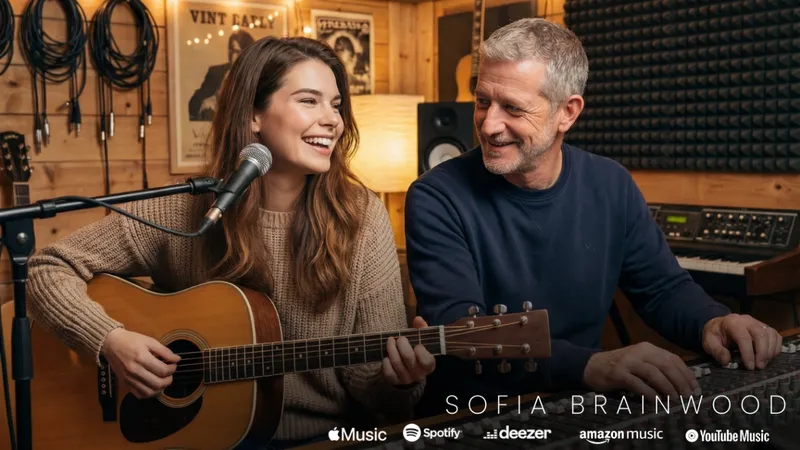
Drawing on my experience as a generative AI trainer at the Toulouse Chamber of Commerce (CCI), where I have worked with hundreds of employees and entrepreneurs, I recently took on an exciting personal project: creating a virtual singer. This new challenge has had me hooked for more than three months now.
This project grew out of deep intellectual curiosity and a strong interest in music, in response to the heated debates about the impact of these tools on the music industry. My goal is to better understand how generative AI is changing this established art form.
Launching Sofia Brainwood, my virtual singer, is the result of a passionate exploration. This article details my whole creative chain, where AI plays a part at every stage, under my direction (I write the first draft of the lyrics myself):
- Strategic design: defining the creative direction and creating the artist's background.
- Lyrics: writing and refining the lyrics.
- Music production: composition and arrangement.
- Audio finishing: editing and touching up the music.
- Release: distribution on streaming platforms.
- Image and communication: creating the visual identity (photos and videos) and running the social networks.
AI is everywhere, but at every step, human input (the “human in the loop”) is crucial. It guarantees decision-making, quality assessment, rejecting what doesn't work and trying again. AI is not a magic solution; it's a set of powerful tools that multiply my creative capacity and productivity.
Why this project? Beyond technical curiosity
Blown away by the first features of Suno, the AI tool that can generate complete songs from a simple prompt, I quickly explored the potential of its paid version. My ambition: to create made-to-measure songs, refining my own lyrics with AI and bringing to life a virtual singer who embodies my musical taste (folk-pop). The realism of this first creation sparked the idea of a full artistic project built around this artist.
The real challenge now is to make the most of what AI can do, from composition to editorial management, social media and visual identity, all with recent consumer tools.
Beyond the pleasure of creating, this personal project has a teaching purpose. It is a concrete case study to illustrate the progress of generative AI in the training sessions and masterclasses I regularly run at the Toulouse Chamber of Commerce. This hands-on experience matters for my learners, because it turns theoretical concepts into a real, innovative example.
The context: numbers that stand out
The impact of artificial intelligence on the music industry is now a global phenomenon.
The success of AI music is striking: one song reached No. 1 on the US Billboard country digital chart. The AI R&B artist Xania Monet, created by Talisha Jones with Suno, is another notable example: with 17 million streams in 2 months, she entered the US charts and signed a $3M deal with Hallwood Media (in French) in September 2025.

This rise is confirmed by Deezer, which reported in September 2025 that more than 28% of the tracks delivered to its platform each day were AI-generated (30,000 tracks a day), compared with only 10% in January 2025.
AI's efficiency raises concerns. An Ipsos/Deezer study found that, in a blind test of three songs, 97% of participants could not correctly tell which ones were AI-generated, and more than half said the result made them uneasy. It makes me think hard about the impact of AI on the future of music and artists.
Transparency first
I chose to be completely transparent about the use of AI at every step of my process, an ethical choice that is essential to build trust.
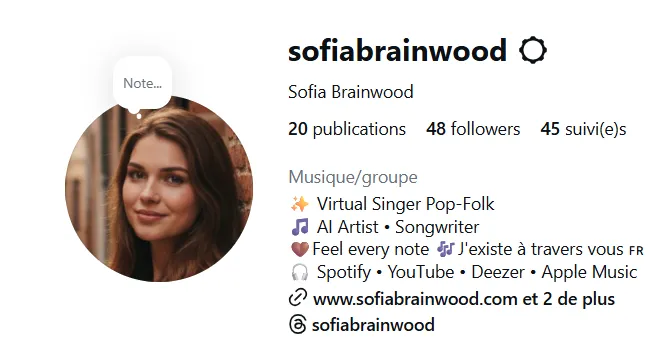
AI-assisted music creation can feel uncomfortable, especially if you are a musician yourself. But by seeing yourself as the producer of a digital work rather than as a musical artist, you can step back. This approach frees you from the feeling of taking over the work of real musicians, and brings back the joy of creating.
The challenge of folk-pop
Choosing folk-pop for Sofia Brainwood, though it reflects my musical taste, wasn't the easiest option technically. Folk-pop relies heavily on the authenticity of acoustic instruments and minimal production, where AI's imperfections are much more obvious. In its current form, AI finds it easier to generate styles where digital effects and standardization are more accepted, like electronic music or lo-fi. These genres leave more room for “hallucinations” (AI errors) without them being heard as flaws.
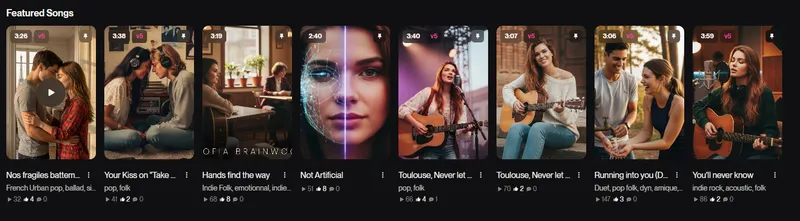
The songs from this period are on the page of Sofia's singles.
Working across musical styles
Despite this early complexity, the project grew. Today, Sofia Brainwood has a varied repertoire:
- Bilingual: the songs are created in English and French, and I sometimes have to change a few words to get the pronunciation right.
- Different formats: I have produced solos but also duets, which adds complexity to the prompting to handle two distinct voices (a duet example: Running Into You).
- “Live” version: I even managed to generate a live version of one of my songs by describing the atmosphere and sounds of a stage performance, which shows how flexible the tool is becoming for alternative arrangements (example: Toulouse, Never Let Me Go live).
From musician to producer
As an amateur guitarist, I see myself as a poor musician, but a musician all the same. With the help of artificial intelligence, I take on the roles of lyricist, composer and producer. I direct the creative process, refine the prompts and make musical choices about the instrumentation. In the end, I usually have to generate no fewer than a hundred versions of a song before I get a result I'm happy with and can release on streaming platforms.
AI is a powerful engine for creativity. But the quality of the final result depends on your starting intention, the preparation you do and, above all, your own taste and musical creativity.
The creative chain: from A to Z with AI
Here is my music creation process in detail, with some information about the tools I use at each step.
Editorial strategy and context
It all starts with an idea. For Sofia, I imagined an artist connected to Toulouse, with a bilingual folk-pop sensibility. That direction wasn't chosen by AI: it came from my wish to tell a story. But I built the artist's whole world with Perplexity: her biography, her musical philosophy, the themes of her songs. It helped me structure the creative vision and build a consistent world for my singer.
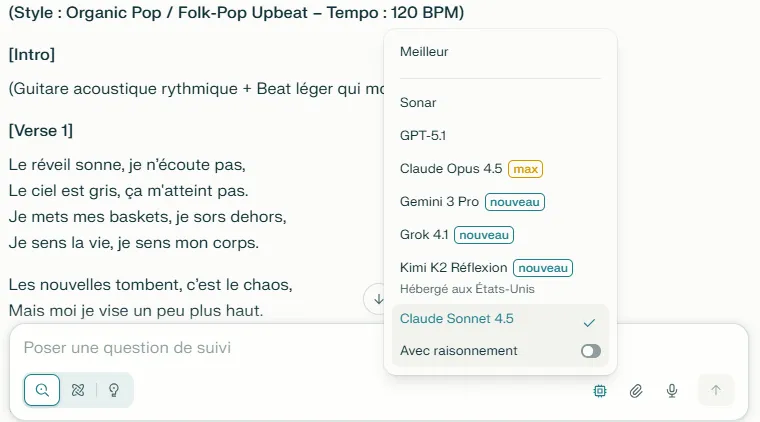
I use Perplexity Spaces, which let me gather all my resources and, above all, choose the LLM that best suits each need (in the paid version): Claude's model to rework my lyrics and Gemini's models for social media.
From story to lyrics
Even though Suno can generate lyrics, I prefer to prepare them beforehand from my own, often imperfect, lyrics. I define an emotion, a situation, a point of view, and let AI polish and complete the lyrics.
AI can generate text, but generating good lyrics is another story. I rewrite, adjust the rhymes and make sure the lyrics fit Sofia's voice and identity. In my Perplexity space dedicated to lyric writing, I keep the previous lyrics along with key documentation on folk/pop songwriting best practices (verse structure, rhymes, and so on).
Composing: Suno and prompt optimization
This is where Suno comes in. And first, an important warning: generating a good song requires mastering prompt writing.
It's not enough to say “make me a light pop song from these lyrics”. Ideally, you work with prompts in English that specify the overall atmosphere, the vocal style, the main instruments, the key and the tempo. For example:
Soft emotional bedroom-pop song, whisper and intimate tone emphasis on “diary-like confession”
Acoustic guitar, light lo-fi drums, subtle ambience
Dynamic contrast: soft intro → emotional chorus → fragile bridge → gentle outro
Mood: bittersweet, tender, vulnerable
Keywords: unsent messages, quiet feelings, soft heartbreak, warm timbre
Tempo: 88–92 BPM, Key: B major or G# minor
That's for the general prompt, but if you want to go further, you can add instructions inside the lyrics themselves, for example:
[Intro]
(Folk-Pop, Acoustic Guitar Fingerpicking, Soft Percussion)

[Verse 1]
(Intimate, Fingerpicked Guitar)
Un week-end dans la ville rose
Je cherche un coin et me pose
The river knows, the bridges know
Once the style and lyrics are set in the prompt, with the specific instructions, you can fine-tune the result with the creation settings. After clicking “generate”, you get the first two versions of the song.
From rough to polished: editing the music
Today's content generation tools, AI music included, have their limits. The first result is rarely perfect and often follows the instructions only partly. So adjustments are essential after a first listen: changing lyrics, refining prompts and generating again. You repeat until you get the version you want, the one that “finally gives you the chills you were hoping for”.
My own experience shows how demanding this becomes: while my first songs satisfied me after about thirty tries, I have become much pickier. I now spot the small flaws (the “hallucinations”) that make a track unusable, which very often leads me past 150 generations for a single song.
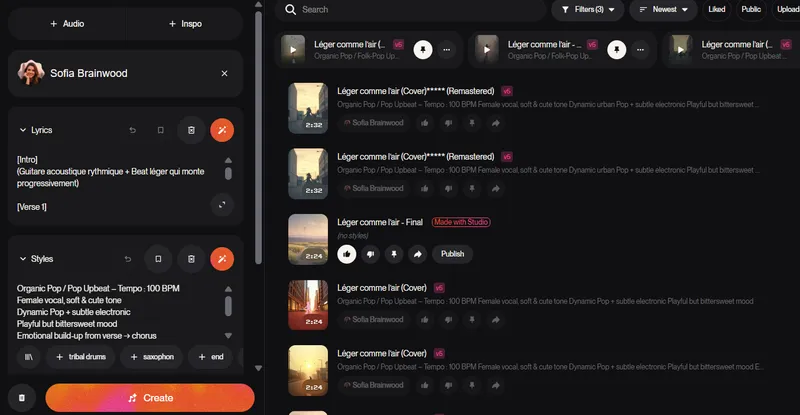
Editing: still limited and frustrating
The most frustrating flaw of these tools is the correction process. Changing a single setting generates a brand-new song rather than modifying the existing one. It's reminiscent of early 2025 when, to edit a photo with tools like ChatGPT or Gemini, asking for a hat created a new image, sometimes with a different subject. Fortunately, since June, tools like ChatGPT and Gemini Nano Banana let you retouch a detail without changing the whole photo, a major step forward that unfortunately isn't available in Suno yet.
Splitting into tracks: the “DAW”
To make editing generated music easier, Suno 5 now includes a “Studio” tool, which splits the song into separate tracks (vocals, backing vocals, drums, guitar, and so on).
In music editing, this is reminiscent of a DAW (Digital Audio Workstation), which lets you adjust volume and other settings track by track. This step lets you refine each instrument individually, or even replace it with a different version of the instrument.
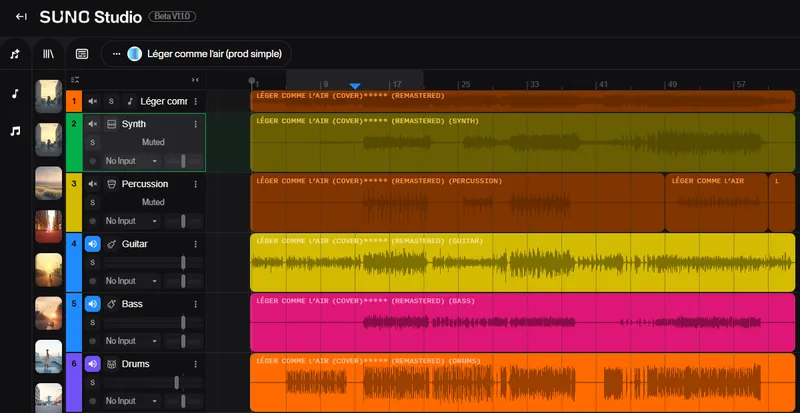
For musicians, looking at how Suno builds a song reveals some peculiarities. When you isolate the tracks (the drums, for example), you notice that the instrument only plays intermittently. Although this is hard to hear in the final mix, listening to the track alone shows that AI works differently from a musician.
The result is that it's very hard to rework the music afterwards with this tool. This confirms that the skills of professional musicians remain fully relevant.
Distribution: making your music available to everyone
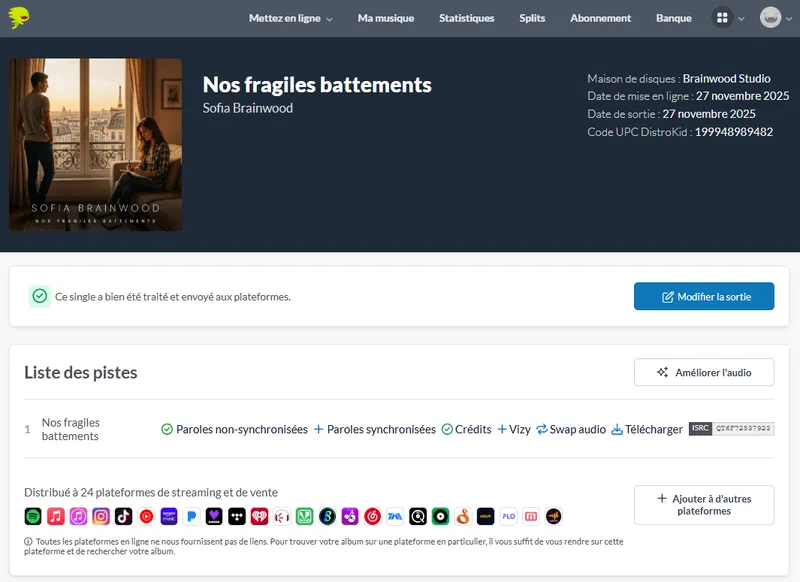
Once you have created your ideal song, you can make it public on Suno and share it with the creator community. But if you want to release it on streaming platforms, tools like DistroKid can automate its publication across all of them (after checking it isn't a copy of an existing song).
Personally, I use DistroKid (a paid service), which has made Sofia's songs available on major platforms like Spotify, Apple Music, YouTube Music, Amazon Music and Deezer, as well as on social networks like Instagram and TikTok. As soon as someone listens to your songs, you have the same distribution rights as a traditional song, so you can earn royalties on the plays.
On to the charts?!
As I mentioned in the introduction, with 100,000 new songs added to Spotify every day, it will clearly take a lot of luck or a big advertising push for your song to reach the top of the charts. The most likely scenario is that you will remain your own biggest fan, and with a bit of luck, your family and friends will support your “virtual singer” too.
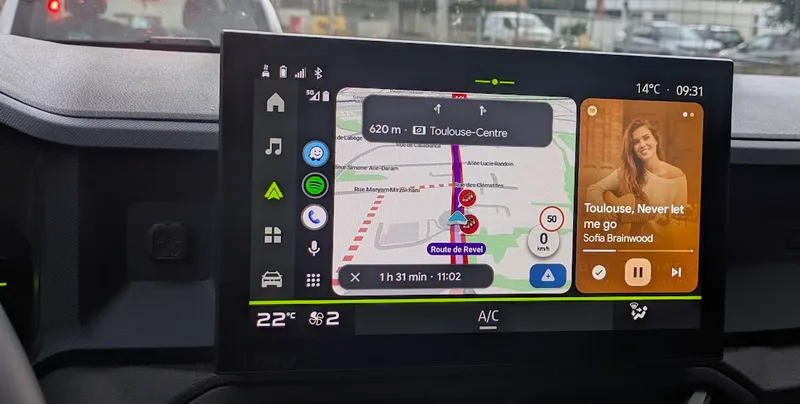
Still, seeing your latest track show up on the car stereo screen via Spotify is a real pleasure, and to borrow my son's words, it's “very satisfying”!
I'm not trying to gather lots of fans. My creations come first and foremost from my personal wish to create and listen to songs that perfectly match my musical taste. And that alone is already great, as far as I'm concerned!
The visual world: from images to music videos
Music is only part of the project. To give Sofia a presence on her website (sofiabrainwood.com), on Instagram and the other social networks, visuals (photos and videos) were essential.
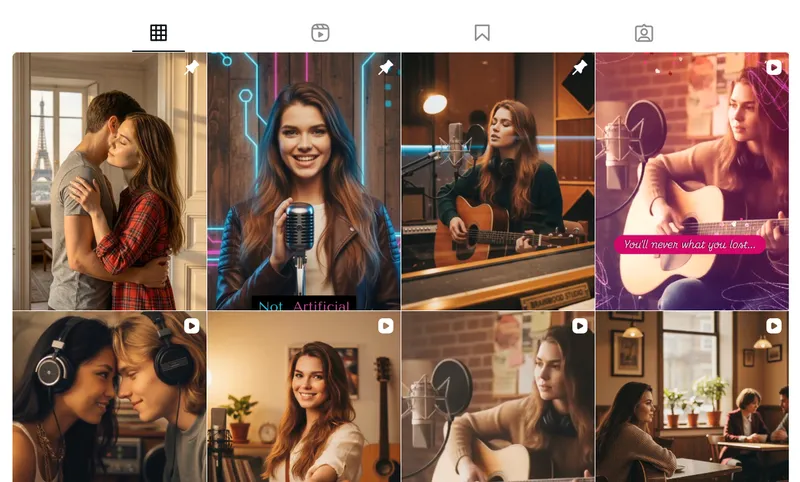
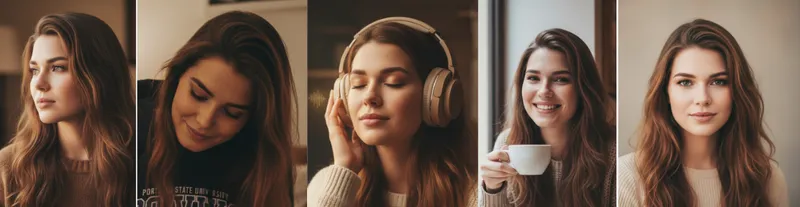
The latest image generation tools make it possible to keep remarkable visual consistency across productions. By choosing Gemini Nano Banana for all the creations, I managed to build a distinctive visual world for Sofia.
Images are useful, but the must-have format on Instagram is the Reel, which needs video content. The available solutions have changed a lot. Although the videos are short (5 to 10 seconds), this format works well with the standard of music videos.
After testing several tools like Veo 3 and Luma, I finally chose Kling for its excellent value for money. I also used HeyGen at first to get very realistic lip sync. However, the latest version of Kling now offers lip sync that is good enough for my project, which lets me bring the whole creation process into a single tool.
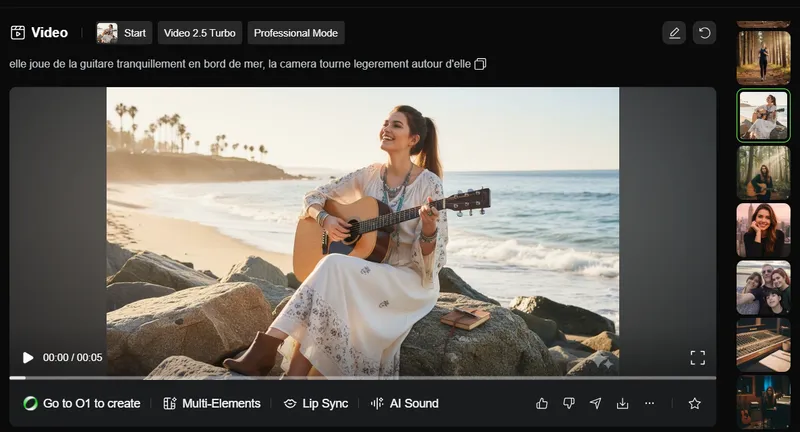
Producing these videos for social media (lip sync, subtitles and design) takes a lot of time. It's hard to keep up a steady pace on Instagram (one new song a week). My next goal is to set up scheduling and automation tools. This will help me reuse my content better and meet the demands of the algorithms.
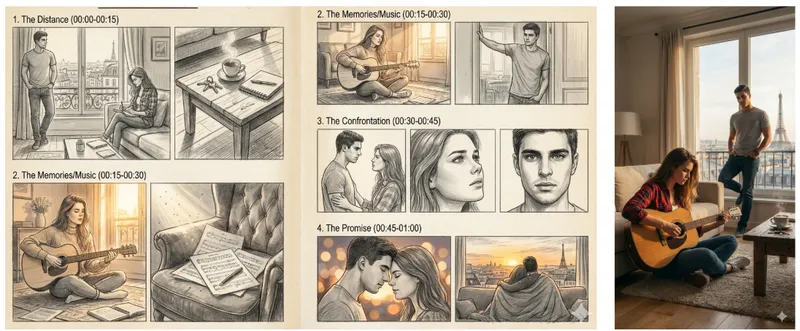
One last example of this AI-assisted creative chain: for my latest video, I gave the lyrics of my song to an AI so it could generate the video's storyboard, designed to last one minute.
This initial storyboard, produced as text, was then turned into drawn boards with the Nano Banana AI. Each visual was then converted into an image, and I used Kling's “image to video” feature on each of them.
The final edit was done in Instagram's Edits app, adding the music track, already listed as a song on the platform.
Taking stock
I take enormous pleasure in making music with Suno. The process is made much easier by the AI methods and assistants I have set up to optimize my whole creative chain.
Although the results match my initial expectations, I find that the creation tools aren't yet mature enough to achieve exactly the sound I have in mind. That takes a very large number of generations, with a fair amount of randomness.
Another major frustration is the lack of diversity in the generated voices, which tend to reproduce the usual standards.
I'm aware that the rise of generative AI will make it even harder for authentic artists to emerge, artists who are already weakened by the music industry, streaming platforms and the standardization of styles. Still, I also know that some artists use these tools to support their own music making.
Before long, with more accessible interfaces, these AIs will let anyone create the songs they want to hear but that don't exist yet.
However, a more worrying prospect is emerging: it's easy to imagine streaming platforms setting up automations. They could generate thousands of songs themselves to fit their own standards, doing without artists and capturing all the royalties.
A personal conclusion
If you have read this far, congratulations! You care about AI and its influence on music production. Feel free to share your thoughts: write to me, or comment on the original article on LinkedIn (in French). As you can tell, this is a real passion for me.
If you are a musician, your opinion is all the more valuable. Not feeling skilled enough to compose a full piece of music on my own with my keyboard and guitar, I chose a shortcut to satisfy both my musical goals and my passion for digital creation.
Six months later, Sofia released her first album: the rest of the story is in Sofia Brainwood releases her first album, co-created with AI.