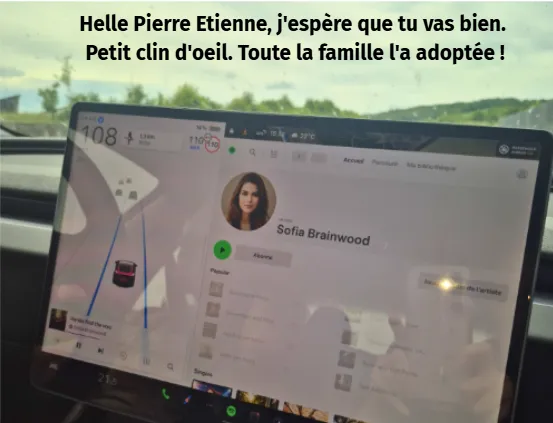
Six months ago, I introduced Sofia Brainwood, my folk-pop virtual singer created with AI. The article got people talking: discussions in my training sessions, questions at the Printemps du Numérique (in French), where I gave a 45-minute talk on the subject to about forty people. For the occasion, I had written a song with Sofia especially for the event, Le Printemps du Numérique, which I played at the start of each of my talks. A concrete way of showing that AI-generated music can also meet a real professional need, not only a creative one.
This article is what came next.
My Blue Hours is out. Fourteen songs. In English. In a style nobody saw coming, me included.
And this time, I want to tell you not only what we created, but above all how we created it. Because even when you teach AI every day, nothing beats experimenting on a real project, and this one gave me concrete examples I could never have made up.
An unexpected turn: from folk-pop to acoustic jazz
It all started with curiosity. With Suno 5.5 (the latest version of the music generation tool), I tried a jazz prompt one evening, just to see. What came out had nothing to do with earlier generations: a real acoustic double bass sound, silences that breathe, a warmth of tone I had never managed in folk-pop.
One listen, and it was decided. Sofia was going to change register.
What surprised me next: some of my old folk-pop songs already existed, with their lyrics and their stories. I had the idea of redoing them as jazz. Same words, same story, but a completely different feeling when you listen. Where the folk version was direct and bright, the jazz version becomes more inward, more suspended. It's fascinating to see how much the musical setting changes the emotion of a lyric.
But generating songs is the easy part. Building an album, with consistency, an emotional arc, a beginning and an end, is another story. And that's where working with AI took on a dimension I hadn't expected.
Claude Cowork: a real creative partner
For this project, I worked mainly with Claude Cowork, Anthropic's desktop tool. And I'll be honest: at first, I expected an assistant that carries out instructions. What I got was closer to an art director you can talk things through with.
The running order, or how to build an evening
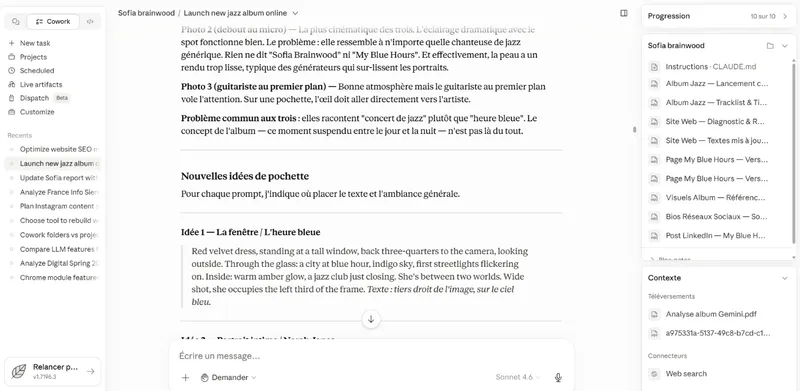
The question that kept me busiest: in what order should the 14 songs go?
My first idea was simple: alternate calm songs and more upbeat ones, to avoid monotony. Claude Cowork suggested something else: analyze the lyrics of each song to draw out the emotional arc, and build a real narrative path, a whole evening, with a beginning, a middle and an end.
We structured the album in four acts: opening (songs 1-3), build-up (4-7), the heart (8-11), resolution (12-14). Each transition was thought through, discussed, sometimes questioned. And it works: the album holds together as a whole, not as a list of songs.
It's exactly the kind of editorial work I do in my training sessions when I help businesses structure their communication. Except this time, it was for a virtual singer. And the AI didn't give me a list: it suggested an approach I hadn't considered.
The moment I had to call on Gemini
There was a funny moment in this collaboration. I needed a precise sound analysis of the songs: the tone, the instruments, the mood of each track. Problem: Claude can't listen to music. It can read lyrics, analyze text, discuss strategy, but it can't hear.
So I called on Gemini, which does have ears. Its analysis was invaluable: it described Sofia's voice as close to Norah Jones or Melody Gardot, spoke of “vocal jazz-pop and acoustic folk”, organic double bass, silences that are full of life. Descriptions I then used in the album's presentation texts.
That moment shows something important: working with AI today means orchestrating several tools, each with its strengths and limits. Neither is universal. It's the human conductor who brings it all together.
The visual identity: 14 prompts, one consistent world
Until then, Sofia only existed through singles. No need for visual consistency from one song to the next: each song lived its own life. An album is different: you need a world that holds together.
Together we defined a shared visual style: digital painting, warm/cool split lighting, visible brushstrokes, zero photorealism. Then we created a specific visual prompt for each of the 14 songs, with the scene, the colors, Sofia's pose and the mood.
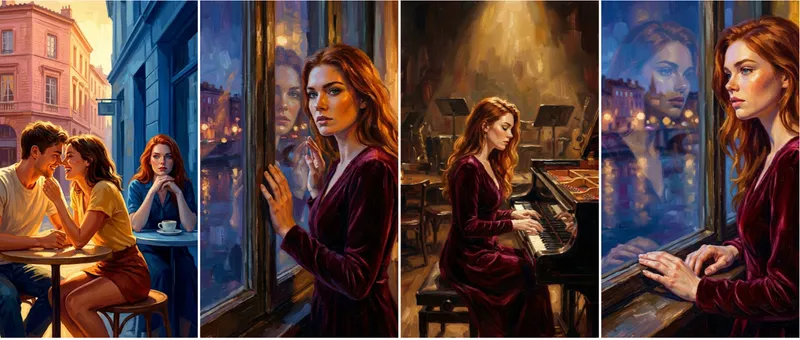
The result: Sofia's world is consistent from one end of the album to the other. You immediately recognize the same palette, the same treatment, the same Sofia, whether you're on song 1 or song 14.
The cover, and my free will
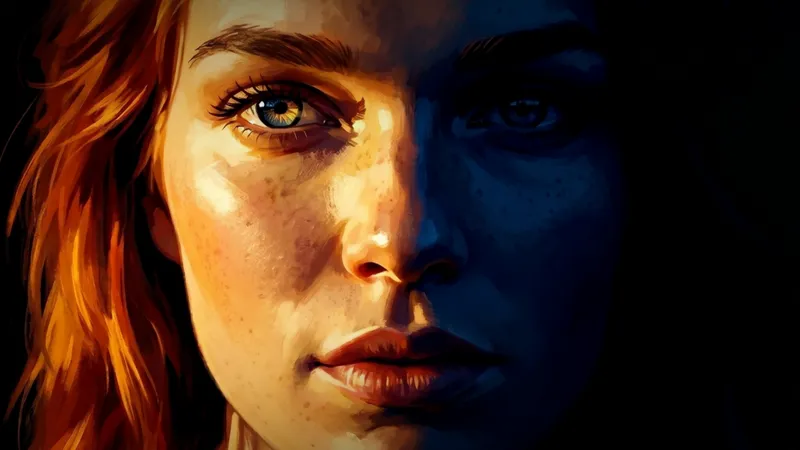
Choosing the cover was one of the most revealing discussions of the project. From 5 concepts (Claude Cowork had given me the prompts), two options stood out: a view from a jazz club, very cinematic, which Claude preferred, and an illustrated portrait of Sofia, her face split in two, half warm gold, half cool blue. A direct gaze. The hint of a smile.
I kept the portrait. Because it moved me more. Full stop.
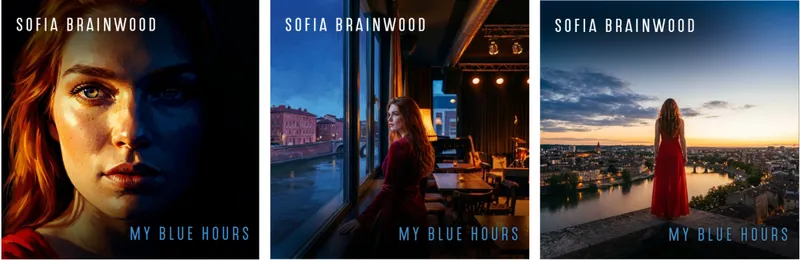
AI helped me, advised me, suggested angles. But the final feeling is mine. And maybe that's the real definition of “human in the loop”: not just approving what AI suggests, but having the last word, and owning it.
What Gemini pointed out later in its analysis confirmed the intuition: the cover is cold and mysterious, while the music is warm and intimate. A tension that says something true about Sofia. Artificial by nature, authentic in her emotions. I wouldn't have put it that way, but that's exactly it.
Sofia's positioning: a real debate
Another exchange that stayed with me: the question of musical genre.
I tended to describe My Blue Hours as “jazz”. Gemini set me straight: it's not jazz in the strict sense. It's acoustic vocal pop with shades of soft jazz, exactly Norah Jones's register, which nobody files under pure jazz either.
Why does it matter? Because I have another project in mind: gathering Sofia's old folk-pop singles into a first album. And if I put too strong a “jazz” label on My Blue Hours, it creates an inconsistency in positioning in the long run.
So we worked on a broader musical identity, one that covers both projects: acoustic voice, stripped-back arrangements, intimate pop. Something like what Norah Jones or Melody Gardot stand for: a register that is precisely hard to define, and that's why it works.
From design to code: the website is live
An album without a website is half a project. The last building block was sofiabrainwood.com, and that's where two other Anthropic tools joined the chain.
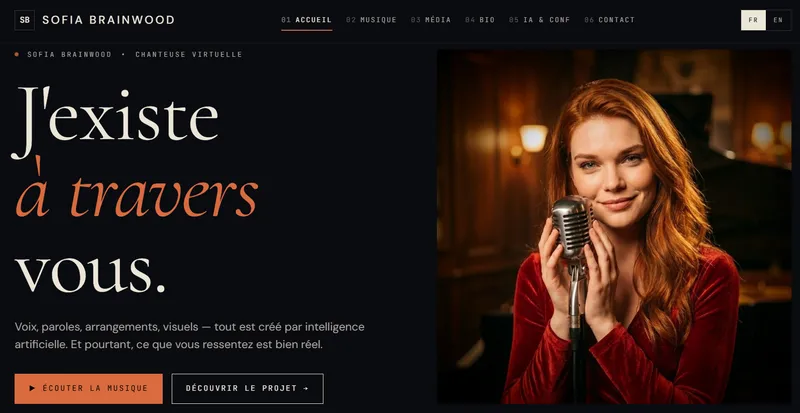
For the visual redesign, I used Claude Design, an Anthropic research preview that I discovered before Claude Cowork itself knew it existed (a funny moment in our conversation 😄). A UI/UX design tool that let me completely rethink the site's structure and visual identity: layout, content hierarchy, consistency with the album's visual world.
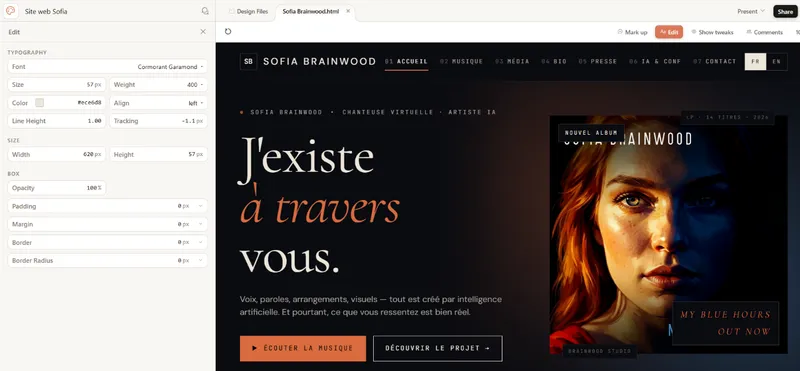
For the technical side, Claude Code took over, a command-line tool for development work. The concrete result: the site now has a built-in audio player (not just a Spotify embed, but a real native player), the SEO has been structured and optimized, and the whole thing holds up technically.
I'm honestly surprised by the result. The design is clean and professional, navigation is smooth, and being able to listen to the songs straight from the site really changes the experience for a visitor. All without writing a single line of code myself.
What's striking overall is how the ecosystem fits together:
- Suno 5.5 for making the music
- Gemini for audio analysis and visuals
- Kling for videos and animations
- Claude Cowork for strategy, editorial work and texts
- Claude Design for the website design
- Claude Code for development and SEO
- DistroKid for distribution to the platforms
Each tool has its place. None does everything. And I'm the one coordinating.
My Blue Hours, the album
I kept this for the end, because it's the reason for all this work.
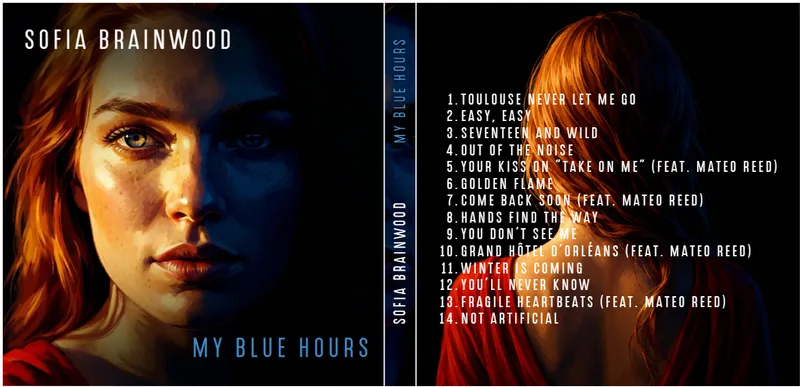
My Blue Hours is a real album. Fourteen songs in a deliberate order, with an intended emotional progression: a whole evening, from light to silence. Listen to the previews on the album page.
It opens with Toulouse, Never Let Me Go, a love letter to the Pink City, carried by jazz instrumentation that sets the tone for the rest of the album. A dive into the atmosphere of this student city. If you don't know it, you'll want to go.
There's also Grand Hôtel d'Orléans, a one-night romance in a real hotel in Toulouse, a place where I have run AI training sessions myself, and whose name I wanted to slip into a song as a nod to its owner. A duet with Mateo Reed, the fictional male alter ego who has been around since the first folk-pop singles. Four duets in all on the album, four moments where two voices look for each other, find each other, or lose each other.
Before talking about the last song, one last story, of a very different kind, that made me think a lot. This week, someone posted a real Monet on X, one of the Water Lilies, passing it off as an AI-generated image, and asked people to explain why it was inferior to a real Monet. The critics let loose. 850-word technical analyses. “The reflections are wrong.” “No consistency in the color choices.” “AI doesn't understand how light behaves on water.” Once the truth came out, most of them deleted their comments.
What this experiment shows, studies confirm (for example Millet et al., 2023): when people don't know a work is AI-generated, they often like it as much as the original. The rejection comes from the label, not the content.
That's no reason to mislead anyone: transparency remains non-negotiable. But it's an invitation to ask the right question: does this music move me, yes or no?
And so, at the end of the album, there's Not Artificial. This song echoes a debate I often see come up, in comments, in training sessions, at talks: can an AI really produce emotion? My answer is simple and can't be argued, only felt: I make this music for myself. If I feel nothing when I listen to a song, I don't keep it. It's that simple. And if the people who listen to My Blue Hours feel something, then they'll forget it's an AI, and focus on the music.
In its sound analysis, Gemini compared the album's style to Norah Jones's, for the warmth of the tone, the intimacy of the performance, that acoustic vocal pop register that takes its time. It's actually quite logical: I've been listening to Norah Jones for years, and I probably unconsciously tried to recapture the style I love so much for its warmth and its comforting side.
🎵 Available on Spotify, Apple Music, Deezer, YouTube Music and every platform, and as previews on the album page.
AI music: it all depends on how you use it
While I was working on this album, two cases showed AI music at its worst.
The first: a France Info report on Sienna Rose, a virtual singer created in total secrecy. Copying real voices (Olivia Dean and Alicia Keys were mentioned), copying influencers' videos, six albums in six months, no transparency about who made it. 95% of the comments were hostile, and rightly so.
The second shocked me even more. Murphy Campbell (@murphydoesnotmatter), an independent folk musician, saw an AI clone her voice from her own YouTube videos, create fake versions of her songs distributed on Spotify under her name, and the distributor of those fake tracks then filed copyright claims against her original videos. The very videos that had been used to train the AI. She lost the income from her own content, to the benefit of those who had stolen it. The story went viral, the claims were eventually withdrawn, but those responsible were never identified.
These two cases illustrate real and serious problems: voice theft, secrecy, and copyright used as a weapon against the artists themselves. The anger of independent musicians is completely understandable.
But neither of these cases looks anything like Sofia Brainwood.
Sofia has been transparent from day one: “AI Artist”, stated everywhere, owned in every post. The project has a teaching purpose: it helps me train professionals in AI at the Toulouse Chamber of Commerce with concrete examples. And I'm not trying to compete with artists: I make the music I want to listen to and could never have made otherwise.
The distinction too few people make in these debates: there's a world of difference between predatory, opaque uses of AI music and a personal, transparent creative project that owns what it is. Like someone filming their vacation on a smartphone without competing with filmmakers.
The tool is the same. The intention, the ethics and the transparency are not.
What this project taught me
I've been training professionals in AI for more than two years. And this project gives me concrete examples I could never have made up:
AI isn't a tool that replaces creativity. It's a tool that multiplies creativity, as long as you bring the vision, the direction and the taste. Without human intention, you generate content. With intention, you build a project.
What strikes me most about this experience: the quality of the exchanges. Not orders carried out mechanically, but real back-and-forth, questions asked in return, angles I hadn't seen. A collaboration, in the true sense of the word.
If you're working on a creative, artistic or communication project and haven't yet tried this kind of collaboration with AI, now is the time.
And if you have questions about the creative chain, the tools, the costs or the limits of the exercise: write to me, or comment on the original article on LinkedIn (in French). It's the kind of topic where the conversation is always richer than the article itself.
If you like even one of these songs, then you must share my musical taste. I'll end with a message I received from one of the business owners I trained a while ago…