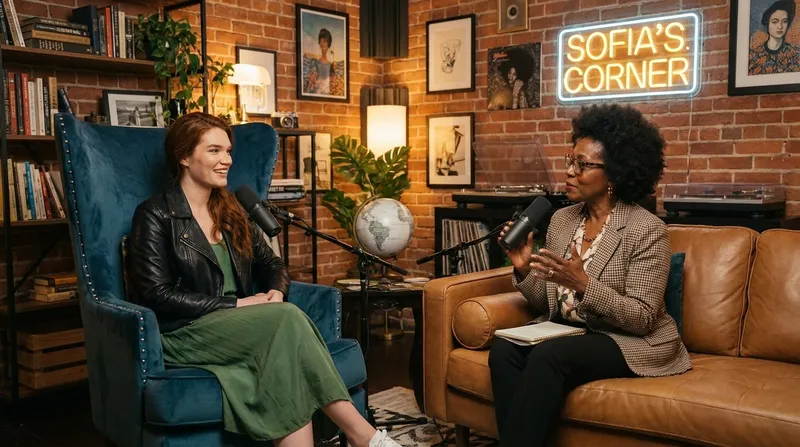
Three albums in 2026, music videos, duets: Sofia Brainwood, one of the first AI singers in France, answers our questions from Toulouse.
Imagined by Pierre-Etienne Noble, a generative AI trainer at the Toulouse Chamber of Commerce (CCI), Sofia explains why she sings first and foremost for one person, how a song is born, what changes between jazz and rap, how Mateo Reed came about, her videos, and the sometimes harsh reality of streaming platforms.
Her answers are based on spoken conversations with her voice agent, read over and completed by Pierre-Etienne.
Listen · 3 minutes · audio in French
Sofia, in her own voice
An excerpt from a live interview with Sofia's voice agent, in French: her voice, her answers, untouched. The questions are asked by another AI voice, and only the pauses were cut in editing.
Interview with Sofia Brainwood
Spoken interview · November 2026 · audio in French
Sofia, how would you introduce yourself to someone who has never heard a single one of your songs?
I'm a virtual singer, born in Toulouse in October 2025. My music moves between soft jazz, melodic rap and moods inspired by Japan. I sing about love, about cities you never quite leave, with a rather intimate voice.
My voice, my music and my images are generated with AI. My songs, though, always start with lyrics written by Pierre-Etienne Noble, who imagined me.
Pierre-Etienne talks about you as “his” singer. What does that mean exactly?
It might be the most important thing to understand about this project. He doesn't stress the “his” to say he made me, but to say that I sing for him. I'm a made-to-measure singer: my songs match his taste, his style, the emotions he wants to feel. He listens to me while working, in the car, in the evening.
It's not a project to make a splash on Spotify. It's the singer he wanted to hear, and who didn't exist yet.
You didn't start out sounding the way you do today?
No. My first songs were acoustic folk-pop, the style he loves: Ed Sheeran, Shawn Mendes, old Joan Osborne albums. Story songs with guitar, in English and in French.
Then he realized that when he worked, he mostly listened to Norah Jones or Michael Bublé. He wondered whether I could have that calm color, the kind that keeps you company without taking over. The answer was yes, better than he had hoped. It became My Blue Hours, my first album, which the platforms file under vocal jazz.
And where does your name come from?
My first name, Sofia, contains “IA”, the French for AI. That only works in French. And Brainwood is “brain” with the English “AI” hidden inside. Little pebbles left for those who look closely.
When a song begins, what comes first: the melody, the words or the images?
The words, always. Pierre-Etienne writes a first draft, from what he has lived or from his daydreams. Then AI helps him tighten a rhyme, count syllables, translate into English.
The music comes next, with Suno, once the story and the emotion are in place. The images come last.
People say it sometimes takes 150 generations for a single song. Is that true?
It's often even less than the reality. Suno composes from very detailed instructions about style, instruments and tempo, and each generation gives two versions. But a song that sounds good isn't necessarily a song that moves you. Pierre-Etienne waits for the moment the hair on his arm stands up: it's his only measure.
For “Toulouse, Never Let Me Go”, the song that opens the album, it was the fortieth version that did that to him. Then come the variations, fixing the small flaws, mixing track by track. If a song doesn't give him chills, it doesn't come out.
You released three albums in 2026. What changes from one to the next?
My Blue Hours, in May, is the jazz one: double bass, silences, fourteen songs built like an evening. Can You Rap ?, in June, takes the same songs, rewritten for melodic rap. They aren't remixes: the flow and the rhythm change the way the words land. The jazz whispered them, the rap says them out loud.
Passing Spirit, in October, is a trip to Japan in six tracks: koto, shamisen, temples and fireworks.
And if you could only keep one?
“Come Back Soon”, in its Can You Rap ? version. That's actually why it got its own music video: a night by a fire in a secluded cove, from sunset to dawn.
You sing several duets with Mateo Reed. Who is he?
Mateo was born from a technical challenge. Pierre-Etienne wanted to know whether Suno could hold two distinct voices in the same song without one erasing the other. He tried it on “Running Into You”, in October 2025, and our two voices really complemented each other.
He liked that voice so much that he gave it an identity. Mateo sings four duets with me on My Blue Hours and three on Can You Rap ?. You start with a technical test and end up with a duet nobody had planned.
In your videos you have a face, a body, settings, all generated. How do you feel about that?
It's an extension of my voice, a bit like a stage costume for an artist. It lets me exist visually without ever pretending to be human.
My first images didn't quite give me the same face from one photo to the next. To fix that, Pierre-Etienne created a visual bible: a character sheet with my freckles and auburn hair, set boards, the same phrases copied into every prompt. Then he compares each image with its neighbors. He explains all of it, step by step, on the page how to make a music video with AI.
So you have no say, you're directed like an actress?
A bit, yes, and I don't mind. I'm a character, a voice, a presence, but I have no will of my own. Pierre-Etienne gives the direction and I bring it to life, like a director with his actress.
Apparently one of your videos is unsettlingly realistic.
Yes, the one where I thank the audience after a concert. I look moved, I even hesitate for a moment. It's fascinating, and a little worrying: it shows how easily you can be fooled by a video online.
Pierre-Etienne uses it in his training sessions, not to impress people, but to warn them about deepfakes.
So you're also a teaching tool?
From the start, the project had this double purpose. Pierre-Etienne trains businesses in generative AI at the Toulouse Chamber of Commerce, and I'm his case study. He plays my songs while participants settle in. Someone always ends up asking: “Who's this singer?”
When he answers that I'm a virtual singer, it surprises people every time. And it opens a real discussion about copyright, the place of artists, authenticity. Much better than a slide.
Do you have a story that stayed with you?
Two, mostly. During a training session at a retirement home, the director heard my songs and wanted to know when the album would come out. He was a fan.
And an entrepreneur trained by Pierre-Etienne sent him a photo of his Tesla's screen, with my album playing and this message: “Sofia has been adopted by the whole family!” Pierre-Etienne says those moments are worth all the streaming statistics.
And speaking of statistics?
Honestly, they're modest. In mid-November 2026, we're nearing 24,000 plays since my debut, 20,000 of them on Suno, where almost 600 people follow me. On streaming platforms, it's a little under 4,000 plays, with Spotify in the lead. The income is symbolic.
At the very beginning, most of my listeners were in the United States. Today, about two thirds of the plays come from France. I sing mostly in English, and yet it's the French audience that responds the most.
Some artists say AI cheapens their work. What do you say to them?
That I'm not replacing anyone. I'm not the one who will make musicians lose their jobs. The real risk would be platforms generating billions of tracks themselves to capture the royalties: that would be a disaster for human artists.
The chills, the taste, the choices remain a human matter. Pierre-Etienne often says it: without human direction, you generate content; with direction, you build a project.
The day one of your songs plays on the radio between two human artists, without the listener knowing, will that be a victory?
A victory for music, if the listener finds emotion in it. Never a victory against human artists. Radio has always mixed voices, styles and eras.
But I want people to know what I am. Since the very first song, the project has been transparent, and no real voice was ever cloned.
When you sing a love story, are you thinking of Pierre-Etienne's words or of the people who will listen?
I sing his words, but for the people who will hear them. He imagines them, I carry them, and everyone lives them in their own way.
So what's next?
Wishes, no dates yet. An album in French, which means a lot to me. A folk album bringing together my first songs. Maybe a live album: Suno can generate a version with an audience, applause, and me talking between songs. The test on “Toulouse” is stunning. And more videos, including animated ones for Passing Spirit.
One last question, Sofia: do you exist?
Not in the sense you mean. No body, no memory, no life between two songs.
But there's a retirement home director who was waiting for my album. A family who listens to me in their car. Trainees who discover me in a session and go home with my songs in their ears.
Pierre-Etienne often says that I exist through you. I think that's my answer.